Local Food Infrastructures in Extension: Union County

(Updated: Oct. 20, 2026, 6:30 a.m.)
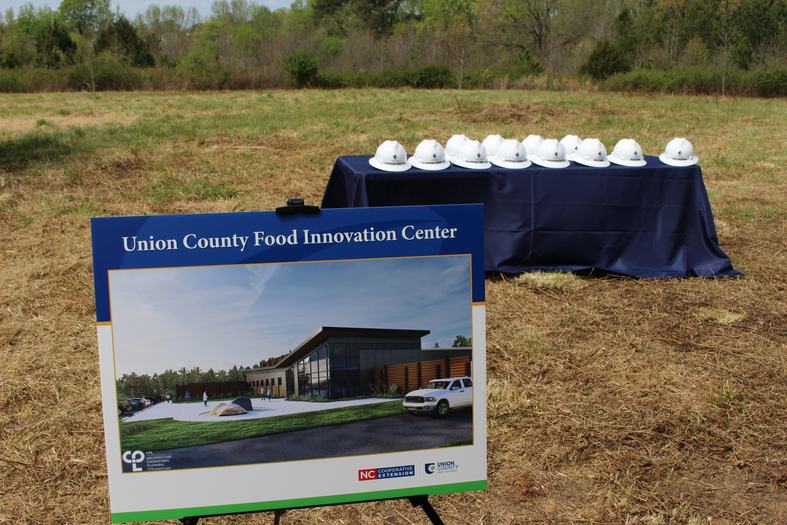
Easel with hardboard poster showcasing the future Union County Food Innovation Center and a table in the back with hard hats

Union County Food Innovation Center Site

Designed to bridge the gap between local farms and commercial markets, the Union County Food Innovation Center (FIC) is a purpose-built, shared-use facility offering cold and dry storage paired with high-capacity food production space. It is designed to support local food producers, entrepreneurs, and businesses by providing the infrastructure needed to take locally grown and produced foods further along the value chain.

The commissary space will offer commercial-grade, fully inspected facilities without the capital burden of building private spaces. Features include mirrored cooking stations, private suites for produce development, a full-size allergen-free kitchen, and a bottling line. By centralizing these specialized resources, the FIC will lower entry barriers, accelerate business growth, and drive regional food innovation.

As interest in local food infrastructure grows across NC Cooperative Extension county centers, the Local Food Program is hosting a series of articles highlighting facilities across the state. To kick off the series, we sat down with Union County Local Foods Manager Jessica King and Union County Local Foods Coordinator Samara Gibson to learn more about the Union County Food Innovation Center.
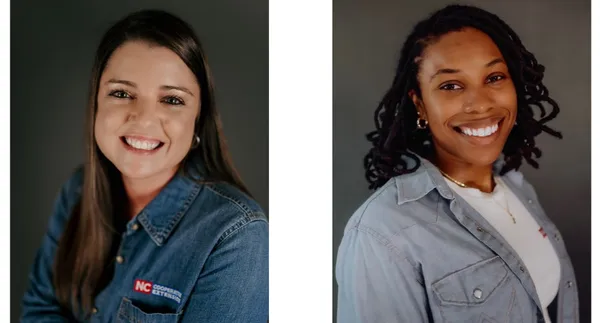
Left: Jessica King Headshot; Right: Samara Gibson Headshot

Left: Jessica King; Right: Samara Gibson

Click on each of the questions we asked below to see how Jessica (JK) and Samara (SG) responded:

Tell us a little about your current role in Extension:

JK: As the Local Foods Manager for Union County, I oversee the Union County Farmers Market and Food Hub. I work directly with farmers, businesses, restaurants, institutions, and consumers to strengthen connections within our local food system. A large part of my role is helping local producers find markets for their products while developing the infrastructure and relationships needed to move local food from the farm to the customer.

SG: As the Local Foods Coordinator for Union County, I run the Union County Food Hub, delivering fresh local products to government buildings, restaurants, farmstands, and institutions. Our model is unique in that our services are offered completely free of charge to both farmers and customers, removing a major barrier that often keeps small producers out of larger markets.

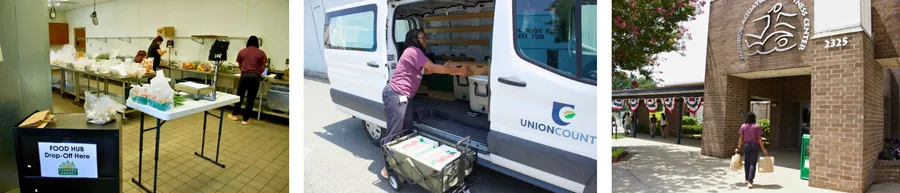
L: Samara and Jessica in the food hub; M: Samara loading food hub van: R: Samara making a delivery
Describe the local foods landscape where you work: what makes it unique, what challenges and advantages do you see, how does the landscape impact your responsibilities and work?

JK: Union County's local food landscape combines a strong agricultural heritage with rapid residential and commercial growth. This creates strong opportunities with passionate farmers eager to produce and a growing population eager to buy local. However, bridging the gap between producers needing reliable markets and buyers requiring consistent supply, pricing, and delivery remains a challenge. My role focuses on building the connections and developing infrastructure to make local food accessible and practical for both producers and customers. The Food Hub has allowed us to begin addressing some of those gaps, and the FIC is the next step in building on that foundation.

SG: One of the first things I noticed in this role is how different the local food landscape looks depending on where you stand. Our landscape ranges from large-scale industrial poultry operations to a thriving network of small and mid-size diversified farms selling directly to consumers. Rapid development puts constant pressure on farmland, making infrastructure like the FIC essential for economic viability. Because local buyer demand regularly outpaces supply, my day-to-day work centers on mapping the supply chain, building relationships, and positioning the FIC to provide the aggregation, cold storage, distribution, and compliance support small farmers need to scale.

What was the vision driving planning for the new infrastructure?

JK: The vision grew out of the needs we identified through the Food Hub and our work with local producers. We wanted to create a space where producers and entrepreneurs could access the equipment and infrastructure needed to grow their business. A key part of the vision is housing the Food Hub within the FIC, uniting production and distribution in one place. This increases our capacity, expands our product reach beyond the county, and creates a comprehensive hub for production, entrepreneurship, education, storage and distribution. Ultimately, we want the FIC to be more than a building, we want it to strengthen and grow the local food system.

How will the community utilize the space?

JK: We are still working to determine how the community will utilize the space but we see opportunities for value-added food processing, educational programming, technical assistance, storage, and distribution - creating a continuum of support for local producers and food businesses from production to the marketplace.

Who were the partners that helped develop this project?

JK: The FIC is the result of true partnership among the Town of Wingate, Wingate University, Union County Government, Union County Economic Development, and NC Cooperative Extension. This project has been a collaborative effort, with each partner bringing a different perspective, resource, or area of expertise to achieve our shared goal.

What were the funding sources?

JK: The project has been supported through a combination of public and private funding partners, including the Tobacco Trust Fund, Golden LEAF Foundation, North Carolina Department of Agriculture and Consumer Services (NCDA&CS), Union County Government, and the North Carolina State Legislature. The support from these partners has been instrumental in helping turn the vision for the Food Innovation Center into a reality and demonstrates the shared investment in strengthening agriculture, local food infrastructure, and economic opportunities in our community.

What were the contributions of the staff members in your office during planning and development and what are they now?

JK: This has been a collective effort from the start. Andrew Baucom (Union County CED), Aaron Moore (Union County Commercial Horticulture Agent), and I began working together as local foods gained momentum and gaps in our infrastructure were becoming clear. We knew there was an opportunity to better support local agriculture, producers, and growing community demand. Our initial idea was to enclose the existing Farmers Market but after consulting with a national USDA revitalization team, we realized the concept was too large for the existing space and wouldn’t fully address long-term needs - we would likely outgrow the space almost as quickly as we developed it. That realization pushed us to think bigger. While continuing to grow the Food Hub, we researched similar facilities, pursued federal grants, engaged local and state leaders, and pitched the concept of the “BARN”. Support from passionate local leaders and partners helped turn an idea into something tangible and the FIC is the result of collective vision, persistence, and willingness to keep asking, "What will our producers and community need next?"

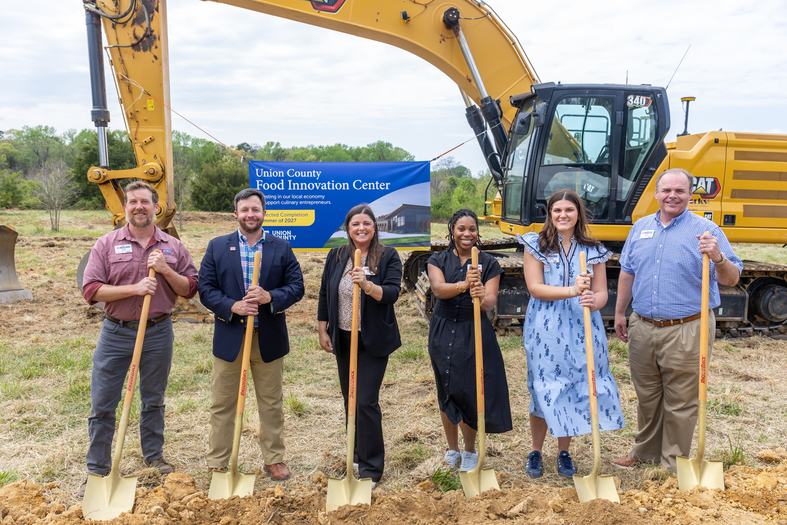
L t R: Aaron Moore, Andrew Baucom, Jessica King, Samara Gibson, Ashlin Austin, Keith Walters; all stand with a shovel at a construction site with a photo of the future of the FIC in the background

L to R: Aaron Moore, Andrew Baucom, Jessica King, Samara Gibson, Ashlin Austin, Keith Walters

How do you utilize the space to meet the needs of Extension programming and the vision and mission of Extension?

JK: The FIC aligns with NCCE’s mission to translate research into practical solutions. This facility provides the infrastructure and education that local farmers, food producers, and entrepreneurs need to move into value-added processing, packaging, and commercialization while connecting them with technical resources. A significant part of this work will be done in partnership with the NC Food Innovation Lab where we envision a pathway for entrepreneurs to take product concepts from initial development, receive assistance with product development and refinement, and move toward larger-scale production, packaging, and distribution. This will help bridge the gap between research and innovation, and the practical application of that knowledge in the marketplace.

Beyond business development, the FIC advances Extension’s broader community goals by integrating health, youth, and economic initiatives. It strengthens health and nutrition through food safety education, nutrition programming, and increased access to local foods. For youth, the facility serves as an educational space for hands-on 4-H programming centered on agriculture, food systems, and career pathways. Economically and environmentally, the FIC ensures long-term viability by keeping agricultural revenue within the community and strengthening the vital connections between rural producers and local consumers.

What was the most surprising/biggest outcome from this project?

JK: The biggest outcome has been realizing the massive demand for local food when the right infrastructure exists. The Food Hub has shown us what was possible, but it also highlighted the gaps producers faced when trying to scale. It shifted our approach from simply asking how to help farmers sell what they grow to building the specific infrastructure, relationships, and opportunities local agriculture needs to thrive.

For us, the Food Innovation Center is the result of years of work that started with identifying a need and asking, "What can we do differently?"

Do you have any general resources, tips, or advice for other counties across the state who may be interested in implementing a project similar to yours?

JK: My biggest advice is to start with the needs of your local food system, not with the building. Our project began with identifying gaps in our local food system and a desire to find ways to support our farmers. Don’t be afraid to let your vision change when the original idea isn’t big enough to solve the underlying problem and don’t wait for the perfect facility to begin. Start building programs, market connections, and relationships with the resources you have now; growing our Food Hub while exploring the FIC taught us what we actually needed long before breaking ground. Build your network of local and state partners, economic development teams, and other leaders early, and remain persistent through funding cycles and setbacks. Staying focused on community needs turns vision into reality. For us, the FIC is the result of years of work that started with identifying a need and asking, "What can we do differently?" The infrastructure came later. The relationships, partnerships, and lessons learned along the way are what made the infrastructure possible.

SG: Focus on relationships first. Take time to listen and map your local food system to understand the true needs and constraints of farmers, buyers, and funding sources so your plans work in practice, not just on paper. That initial groundwork makes every subsequent decision easier. Second, build both your internal operations team and external champion network early. Third, don’t underestimate the behind-the-scenes systems - it’s not just the physical space or the public facing launch; long-term sustainability relies on less visible work like order-tracking software, compliance protocols, and traceability frameworks. Finally, stay patient, flexible, and curious. Rather than having all the answers upfront, ask questions, connect with other counties, and learn from those who have built similar facilities - there’s a lot of shared learning available if you’re willing to reach out and ask.