Overview
“Collaboration” is the act of two or more persons working together to achieve a common purpose. “Collaborative Farming" or "Multifarm Collaboration” is a farming business that results from the actions of two or more persons or organizations working together to achieve a higher degree of profitability than they would individually. Such collaborations can take many forms. From two or more growers, who after a casual handshake agree to share vendor space at a farmers market, to the formally incorporated cooperative, corporation, or limited liability company that markets members’ products collectively, farming collaborations in North Carolina occur naturally, and most often, as a result of need or adversity.Collaborative farming arrangements across North Carolina vary in type, purpose, size, and effectiveness. No particular legal structure guarantees the potential for profitability. Rather, compatibility, equitable contribution of resources, proper planning, and when feasible, professional management, seem to be the keys to success.
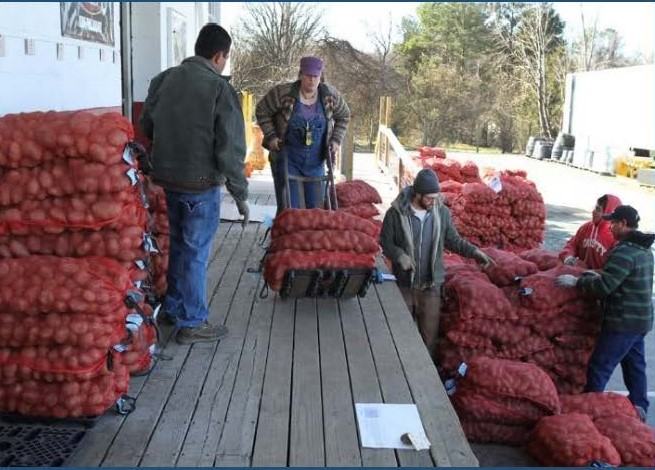
In a 2017 study, small-scale farmers and fishers were found to be the most likely to consider a unique formal collaborative farming or fishing arrangement, such as a cooperative, limited liability company, or S-corporation. Image by Debbie Ross, Chatham County Agriculture Agent
The top reasons cited by interviewees for entering into a unique formally structured collaborative farming or fishing business include:
Access to Markets Formalized Equipment Sharing
Sense of Legitimacy Farmer Engagement
Opportunity to Network Collective Bargaining
Access to Capital Access to Training
Spotlight on Multi-Farm Legal Structures
Local food system development organizes many different parts and players into what hopefully is one manageable whole. What form of legal structure each of these parts (as well as the whole) takes will vary, depending on their objectives, financial positioning, and advice of legal counsel. Consequently, producers, aggregators, distributors, and buyers could each be organized as either a sole proprietorship, partnership, LLC, non-profit corporation, for-profit corporation, or other legal structure.
One type of legal structure that has been around for generations and is often overlooked is the cooperative. Even though you often don’t see cooperatives mentioned in Business and Law School textbooks as a form of legal structure, coops are global with over one billion members. One in four Americans belongs to a coop and may not know it. Cooperative structures include such regional and national businesses as rural electrics, rural telephones, credit unions, and mutual insurance companies. Farmers may also organize cooperatives in order to gain efficiences in purchasing and access to markets.
Read more about the cooperative structure.Spotlight on Collaborative Business Opportunities
The types of collaborative business opportunities for producers are many and varied. For purposes of this article, we will focus on three: multifarm CSAs, farmers markets, and food hubs.CSAs
"CSA" stands for Community-Supported Agriculture. The typical CSA structure involves a farmer pre-selling "shares" in her harvest to surrounding community members. Such presale spreads the risk of production and harvest between the farmer and the consumers who buy such shares. It also provides the farmer with much-needed cash for planting season.Farmers Markets
Farmers Markets are nearly as old as our nation. The first known market started in Lancaster, Pennsylvania in 1730 and continues today. As of 2019, the number of farmers markets in America had grown to over 8,000, reflecting a similar upward trend in consumer preference for local food.
Farmers Markets can be structured in a variety of ways and range in size from very small with limited hours to very large and open year-round. They may be owned privately, e.g., by a single farm that leases space to friends and neighbors, by a non-profit organization headed by an executive director who coordinates the promotion and rental of vendor booths to area farmers, by a local government, or collaboratively through a cooperative or less formal associaiton of farmers. In all cases, a farmers market involves some collaboration among farmers in order for it to be sustainable and effective.Food Hubs
Resources
Collaborative Farming in North Carolina