

Farm to Institution
go.ncsu.edu/readext?251122
en Español / em Português
El inglés es el idioma de control de esta página. En la medida en que haya algún conflicto entre la traducción al inglés y la traducción, el inglés prevalece.
Al hacer clic en el enlace de traducción se activa un servicio de traducción gratuito para convertir la página al español. Al igual que con cualquier traducción por Internet, la conversión no es sensible al contexto y puede que no traduzca el texto en su significado original. NC State Extension no garantiza la exactitud del texto traducido. Por favor, tenga en cuenta que algunas aplicaciones y/o servicios pueden no funcionar como se espera cuando se traducen.
Português
Inglês é o idioma de controle desta página. Na medida que haja algum conflito entre o texto original em Inglês e a tradução, o Inglês prevalece.
Ao clicar no link de tradução, um serviço gratuito de tradução será ativado para converter a página para o Português. Como em qualquer tradução pela internet, a conversão não é sensivel ao contexto e pode não ocorrer a tradução para o significado orginal. O serviço de Extensão da Carolina do Norte (NC State Extension) não garante a exatidão do texto traduzido. Por favor, observe que algumas funções ou serviços podem não funcionar como esperado após a tradução.
English
English is the controlling language of this page. To the extent there is any conflict between the English text and the translation, English controls.
Clicking on the translation link activates a free translation service to convert the page to Spanish. As with any Internet translation, the conversion is not context-sensitive and may not translate the text to its original meaning. NC State Extension does not guarantee the accuracy of the translated text. Please note that some applications and/or services may not function as expected when translated.
Collapse ▲“Nationwide, tens of millions of people each day eat their meals outside of home at schools, colleges, hospitals, corporate cafeterias and government agencies. Each one of these institutions represents an opportunity for U.S. farmers, ranchers and food businesses to gain market share, earn a livelihood, forge ties with local residents, and improve community health and well-being through farm to institution efforts, in which local producers sell to institutions nearby.” USDA Farm to Institution Initiatives. This page contains resources categorized by institutions that could be collaborative partners: schools, preschools, universities and hospitals.
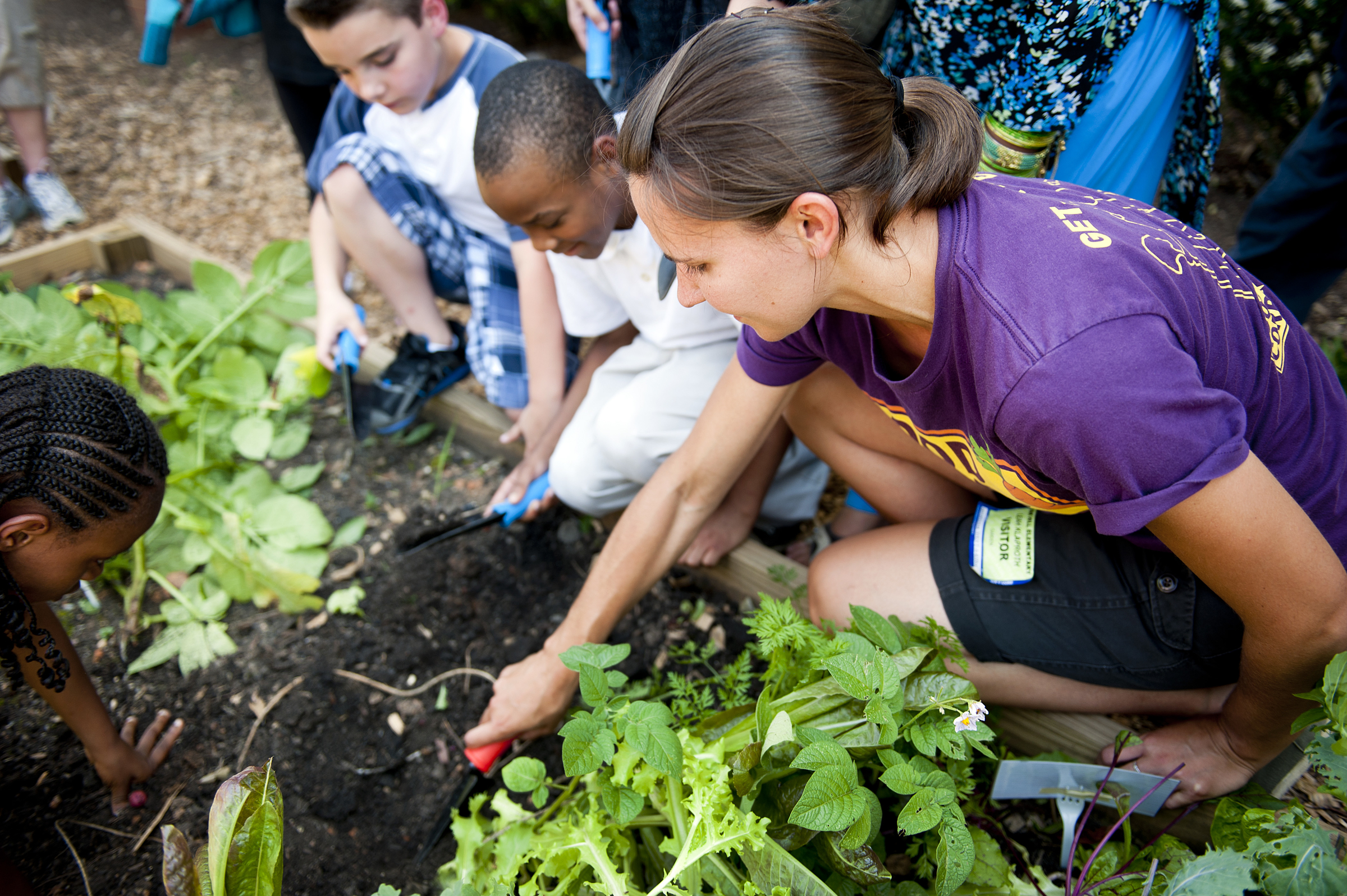
Students discovering healthy foods in the school garden.
On This Page
| Farm to School | Farm to University |
| Farm to Preschool | Farm to Hospital |
| Farm to Senior Services | |
:Farm to School

- Training Template: Farm to School 101 for Educators: Use this training template to teach educators about Farm to School (F2S) and how to incorporate F2S lessons in and outside of the classroom. The template consists of a customizable slide deck, speaker notes, handouts and an evaluation form.
- Bringing Local Food to Local Institutions: An ATTRA resource guide for farm to institution programs. It includes models of farm to institution programs, program considerations and case studies.
- Institutional Food Purchasing: This 2010 report from Michigan Good Food Work Group describes trends, institutional purchasing goals, indicators and agenda priorities in K-12 schools.

- Farm to School: Farm to School is a movement that strives to build a youth’s connection to healthy, local food through school gardening, farm field trips, hands-on cooking and nutrition and local sourcing of fresh fruits and vegetables to school cafeterias. Explore Extension’s related programs and learn how to get your office involved in Farm to School.
- Farm to Cafeteria: Farm to Cafeteria is the process of facilitating and procuring locally grown, GAP-certified produce, meat and seafood from a grower into the school. Check out Extension’s page to learn about sourcing models and state initiatives.
- NC Farm to School Coalition: program brings together local schools, state agencies and organizations together with local farmers to supply healthy nutritious food to our children’s schools. Find Coalition Members near you.
- NC Farm to School: North Carolina Department of Agriculture & Consumer Services Farm to School program supplies school cafeterias across the state with locally grown produce from North Carolina farms.
- National Farm to School Network: National Farm to School Network increases access to local food and nutrition education to improve children’s health, strengthen family farms, and cultivate vibrant communities.
:Farm to Preschool
- Bringing Local Food to Local Institutions: An ATTRA resource guide for farm to institution programs. It includes models of farm to institution programs, program considerations and case studies.
- Institutional Food Purchasing: This 2010 report from Michigan Good Food Work Group describes trends, institutional purchasing goals, indicators and agenda priorities in K-12 schools.
- Farm to Preschool/Childcare: Explore this Extension page that contains information on Farm to Childcare projects, initiatives and other resources.
- NC Farm to Early Care & Education: Farm to Early Care and Education (Farm to ECE) enhances the health and education of young children by developing systems and experiential learning that connect children and their families with local food and farms.
- National Farm to Preschool: This program, based in California, is designed for children aged 3-5 in any childcare setting. They also provide research and evaluation tools, publications and presentations on the topic, and information on local food sourcing.

- Farm to University: Guide for Extension Agents: This publication provides information that N.C. Cooperative Extension agents can use to build a Farm to University program. The information is based on lessons learned working with campus communities over five years in conjunction with two NC 10% Campaign project collaborations: UFoods and the Local Food Ambassador Program.
- How It Works Handbook: University Food Systems and Local Food Programs: This handbook showcases some of the local food initiatives of NC 10% Campaign’s UFoods partner schools.
- Farm to Dorm Cooking Videos: NC 10% Campaign and UFoods teamed up with GeoCore Films to produce a series of dorm cooking videos based on Local Food Spotlight seasonal recipes created by the UFoods project.
- Bringing Local Food to Local Institutions: An ATTRA resource guide for farm to institution programs. It includes models of farm to institution programs, program considerations and case studies.
- Institutional Food Purchasing: This 2010 report from Michigan Good Food Work Group describes trends, institutional purchasing goals, indicators and agenda priorities at colleges and universities.
- NC Farm to University: The NC 10% Campaign has worked with over 20 universities in the state to increase their local food procurement. This work was built from two main pilot projects: 1) The Local Food Ambassador (LFA) Program (2013-2019) provided paid student intern positions at six universities to engage the student body through events and media promotion, support local foods in alignment with the campus sustainability mission, connect university and community advocates, work with dining services to track local food, and build leadership skills in understanding community-based food systems. 2) The UFOODS project (2016-2018) researched supply chain links from farms to university campuses and developed new local food pathways at the six universities that partnered with the LFA Program. The six NC universities are Elizabeth City State University, Fayetteville State University, North Carolina Agricultural and Technical State University, North Carolina Central University, University of North Carolina at Pembroke, and Winston-Salem State University. Resources include a Local Food Ambassador Manual, a Guide to University Food Systems & Local Food Programs, and a Farm to University Guide for Extension Agents.
- ASAP Farm to Institution: This page from Appalachian Sustainable Agriculture Project describes UNC of Asheville’s transition to local food procurement for their dining services to students.

- Farms and Health: A Guide to Farm & Garden Programs in Healthcare, University of Michigan
- Bringing Local Food to Local Institutions: An ATTRA resource guide for farm to institution programs. It includes models of farm-to-institution programs, program considerations and case studies.
- Institutional Food Purchasing: This 2010 report from Michigan Good Food Work Group describes trends, institutional purchasing goals, indicators and agenda priorities in health care.
Farm to Senior Services

- NC Farm to Senior Services (F2SS): F2SS is designed to increase local food procurement in county-based senior food services, increase farmer and food hub revenue, increase access to healthy, local foods for senior populations, and increase knowledge on benefits of and how to access local foods. Resources include a how to guide for building local F2SS programming based on a 2020-2024 F2SS pilot in three North Carolina counties: McDowell, Scotland, and Warren.
Primary Contact:
Robyn Stout
State Coordinator, NC 10% Campaign
Center for Environmental Farming Systems
NC State University
robyn_stout@ncsu.edu